
Why is next month's unlock in the news?
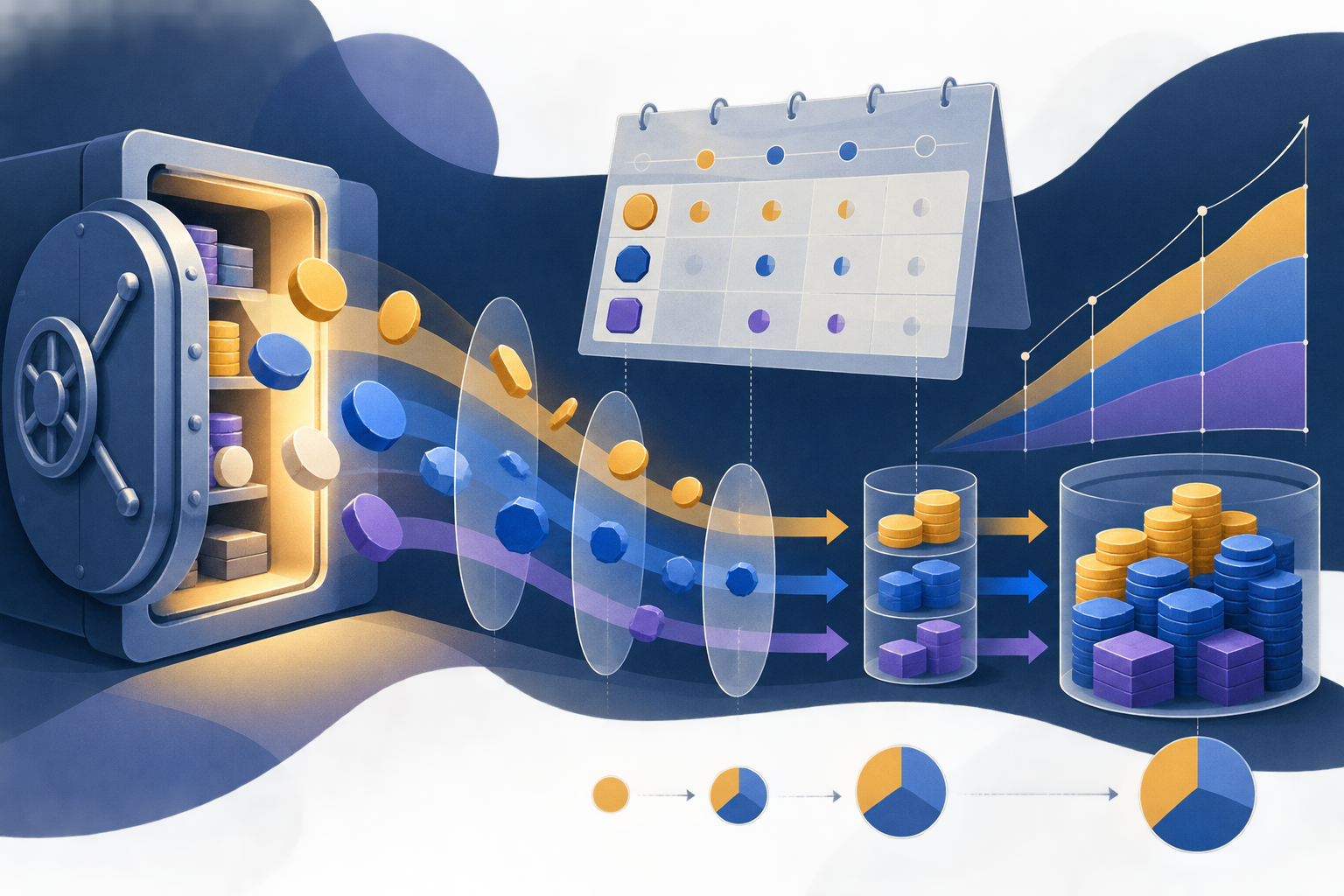
Crypto news regularly reports that some token has "$100 million unlocking next week." An unlock releases previously locked tokens to their recipients on a set schedule, making them sellable. Because it increases the supply that could reach the market, it can weigh on the price.
Not every unlocked token is sold right away, though, and the effect depends on who receives the tokens and why. This guide explains how unlocks relate to circulating supply, how to read vesting schedules, and how to distinguish recipients, using a hypothetical monthly table, and ends with how to check against on-chain records.
Unlocks and circulating supply
Projects typically divide tokens among the team, early investors, a foundation, ecosystem rewards, and community distributions. Team and investor allocations are often locked and released gradually, a process called vesting. Locked tokens are not counted as circulating; when they unlock, circulating supply grows.
As CoinMarketCap's definition of FDV implies, the gap between market cap on circulating supply and value on full supply represents tokens still to come. An unlock schedule is the calendar showing when, and by how much, that gap closes.
Reading a vesting schedule
Vesting usually has two stages: a cliff, during which nothing unlocks, followed by linear unlocking of a fixed amount each month. Some schedules release everything accrued during the cliff in a single month when it ends, so the details matter.
The table models a hypothetical token with 300 million tokens currently circulating. The team's 200 million unlock linearly over 24 months after a 12-month cliff; investors' 150 million unlock over 18 months after a 6-month cliff; the ecosystem's 100 million unlock linearly over 48 months.
| Period | Team | Investors | Ecosystem | Monthly total |
|---|---|---|---|---|
| Months 1–6 | 0 | 0 | 2.08 | 2.08 |
| Months 7–12 | 0 | 8.33 | 2.08 | 10.42 |
| Months 13–24 | 8.33 | 8.33 | 2.08 | 18.75 |
| Months 25–36 | 8.33 | 0 | 2.08 | 10.42 |
From month 13, team and investor unlocks overlap and about 18.75 million tokens unlock each month, roughly 6.25% of today's circulating supply every month.
Who receives the tokens, and why
The same quantity creates different selling pressure depending on the recipient. Early investors who bought at very low prices are likely to take profits; team members may sell some to cover living costs or taxes. Ecosystem rewards trickle out to users and reach the market in small pieces.
Foundation tokens are more often spent on development grants or partnerships than sold directly, but the effect is similar once recipients sell. When reading an unlock schedule, always note the type of recipient alongside the amount.
Checking on-chain
Many projects manage vesting through smart contracts, so a block explorer can show the vesting contract's balance and how much has been released. As Ethereum.org's page on ERC-20 tokens explains, token balances and transfers are publicly visible.
Unlocked tokens moving to exchange deposit addresses can signal a higher chance of selling; tokens moving into staking or other lockups are less likely to hit the market soon. Wallet ownership is often uncertain, though, so these readings are estimates.
Limits on price impact
Unlocks do not always push prices down. The market may already have priced in a well-known schedule, and strong demand can absorb new supply. The CFTC warns that virtual currency prices can move sharply with supply, demand, and sentiment.
Conversely, a modest unlock can matter a lot for a thinly traded token. That is why unlocks should be measured against daily trading volume as well as circulating supply. As a hypothetical example, 18.75 million tokens a month for a token that trades 5 million a day is nearly four days of volume arriving every month.
An unlock checklist
When reviewing a token's unlocks, work through these steps.
- Find the allocation and each recipient group's cliff and linear schedule in official documents and lay them out by month.
- Calculate the next twelve months of unlocks as a share of circulating supply and of daily volume.
- Mark the months where unlocks cluster and the type of recipient involved.
- Use a block explorer to check that vesting-contract balances and released amounts match the documents.
- Check whether the schedule has ever been changed by governance, or could be.
Limits of unlock analysis
An unlock schedule is a plan; whether tokens are sold depends on recipients' decisions. Projects can change schedules, and allocations are sometimes sold in advance through over-the-counter deals.
The schedule here is for a hypothetical token. For a real token, use the latest official documents and on-chain records with their dates, and judge unlocks by their size relative to circulating supply and trading volume.