
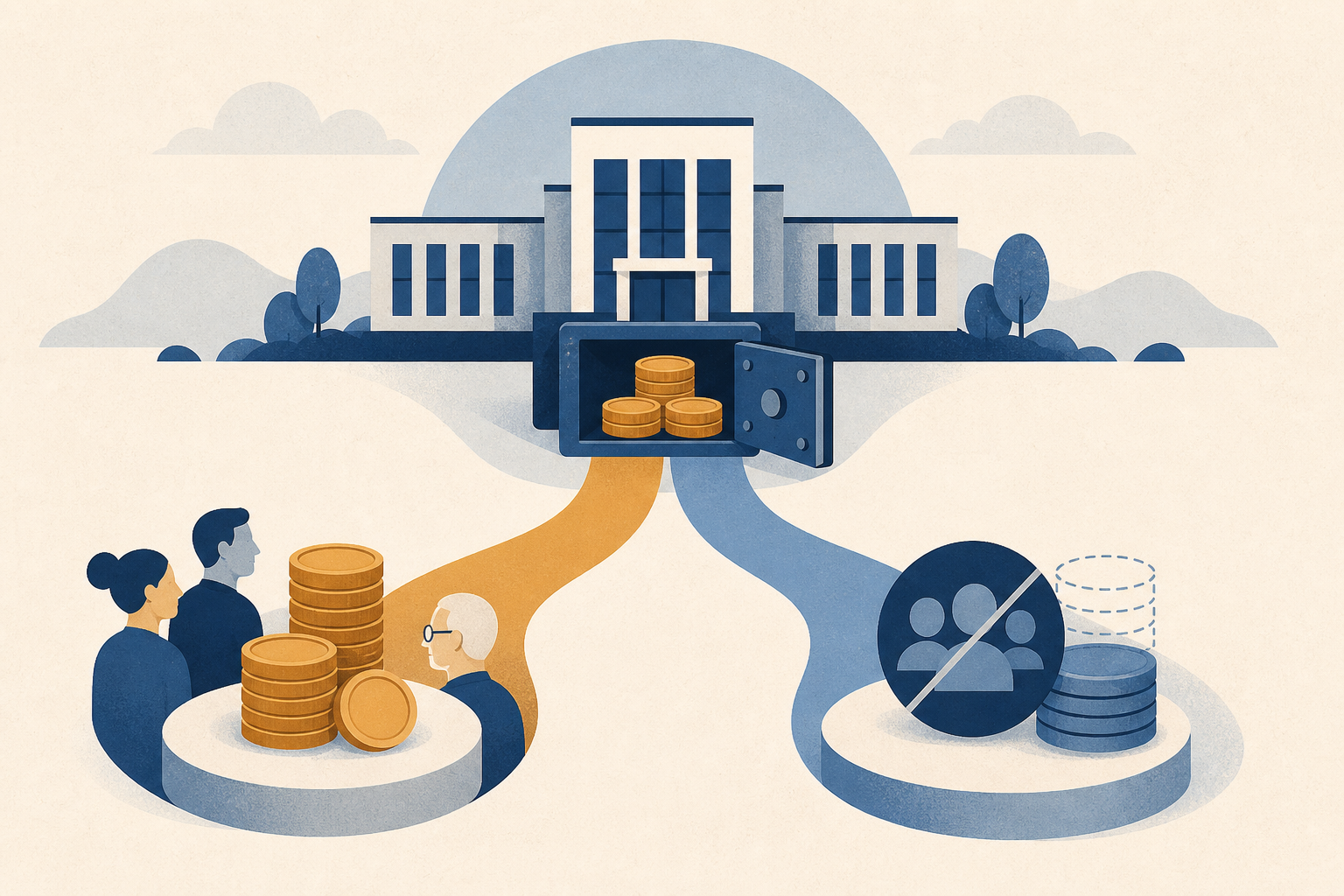
Two ways to return the same money
Companies return cash to shareholders mainly through dividends and share buybacks. Dividends pay cash directly to every holder; buybacks purchase shares in the market and reduce the share count. The same amount of money produces different results for shareholders and leaves different effects on the company.
This guide compares how each approach affects share count, earnings per share, and shareholders' cash, and shows with a hypothetical company why the price paid for buybacks matters. It then looks at how to separate buybacks that merely offset stock compensation from genuine returns, and what to check in the filings.
Two forms of return
With a dividend, every shareholder receives cash in proportion to the shares held. Investor.gov's stock FAQs explain that dividends distribute part of a company's earnings to shareholders at the company's discretion and are not guaranteed. Dividends are taxable when received, and shareholders decide whether to reinvest.
With a buyback, only shareholders who choose to sell receive cash; those who hold end up owning a larger share of a company with fewer shares. Retired shares reduce the share count permanently, while shares held in treasury can later be reissued or used for employee compensation.
A hypothetical comparison
The table compares a hypothetical company with $100 million of net income and 10 million shares spending $60 million on either a dividend or a buyback. Repurchased shares are assumed to be retired.
| Item | $60M dividend | $60M buyback at $150 | $60M buyback at $300 |
|---|---|---|---|
| Shares repurchased | - | 400,000 (4%) | 200,000 (2%) |
| Shares remaining | 10.0 million | 9.6 million | 9.8 million |
| Next year's EPS (net income $100M) | $10.00 | ≈ $10.42 (+4.2%) | ≈ $10.20 (+2.0%) |
| Cash received by holders | $6.00 per share | Only those who sold | Only those who sold |
Buying at a lower price retires twice as many shares for the same $60 million. The effect of a buyback depends far more on the price paid than on the dollar amount.
Why the buyback price matters
A buyback is also an investment decision by the company in its own stock. Buying below intrinsic value benefits remaining shareholders; buying above it transfers value from those who stay to those who sell.
So the question is not how much was repurchased but at what price. A company that buys heavily when its shares are expensive and stops when they are cheap has timed its buybacks poorly; as a hypothetical example, buying at 30 times earnings and pausing at 12 times.
Share count and cash flow
Buybacks raise EPS by shrinking the share count but do not increase net income itself. Under IAS 33, and U.S. GAAP, EPS uses the weighted-average share count, so the timing of buybacks within the year affects how much EPS rises. When reading EPS growth, separate net-income growth from share-count reduction.
In cash terms, both approaches send money out of the company. Dividends, once raised, are widely seen as hard to cut, so companies tend to set them conservatively; buybacks can be expanded or paused more easily and are used more flexibly.
Offsetting stock compensation
Companies that pay employees in stock issue new shares every year. If buybacks mainly offset that issuance, the share count barely falls despite large buyback totals. Take a hypothetical example: issuing 300,000 shares a year for compensation and repurchasing 400,000 reduces the count by only 100,000.
In that case the buyback is closer to paying employee compensation in cash than to returning capital. Looking at how much the share count actually fell over several years is more telling than the announced buyback amount.
Investor.gov's guide to the 10-K and 10-Q points to the statement of stockholders' equity and the equity notes, where both repurchases and shares issued for compensation are disclosed, so the two can be compared directly.
Reading the filings
Using filings on EDGAR, check the real effect of shareholder returns.
- Find repurchase amounts, shares bought, and average prices in the 10-Q and 10-K issuer-purchases tables.
- Record dividends per share and total dividends paid from the cash flow statement.
- Tabulate shares outstanding for three to five years.
- Find shares issued for stock compensation and compare them with shares repurchased.
- Note the valuation (such as P/E) when buybacks occurred and total shareholder returns relative to free cash flow.
Limits of comparing returns
It is hard to say in general whether dividends or buybacks are better. Tax rules, growth opportunities, valuation, and the shareholder base all matter. Borrowing to fund larger payouts adds financial risk alongside the short-term boost.
The company in the table is hypothetical. When assessing a real company, use the latest filings, noting when each was last updated, and judge returns by the price paid and the net effect achieved rather than by the headline amount.