
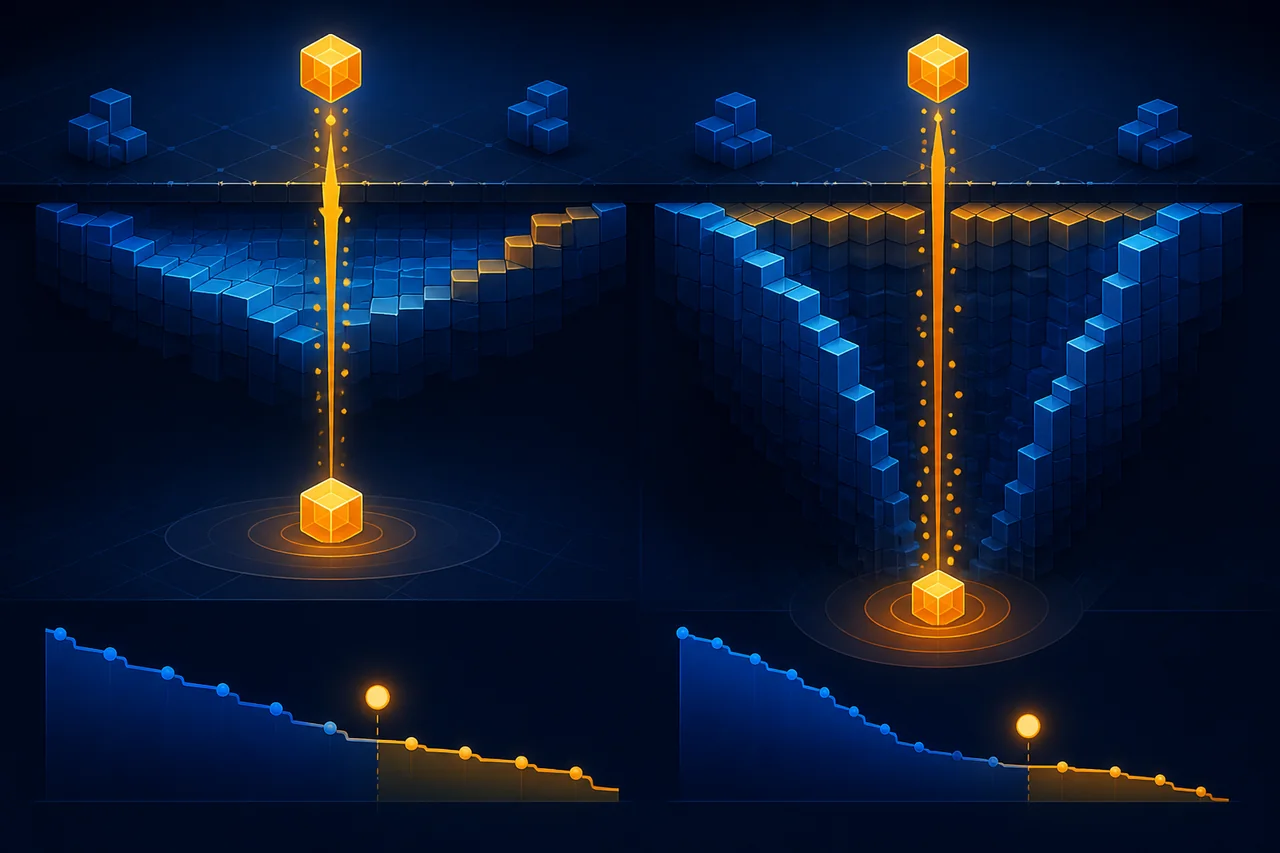
Quoted price versus execution
A price shown on a swap screen does not promise that the full order will execute at that price. Price impact is the movement caused by the order itself; slippage is the difference between the expected and final execution outcome.
How an order moves the price
thin liquidity or a large order can move the order book or pool price by the act of trading. Market orders, AMM swaps, and fast markets each increase execution uncertainty through different mechanics. A displayed estimate assumes conditions at one moment, so it should not be treated as identical to the final execution, settlement, or withdrawal result.
Liquidity and transaction ordering
a wide tolerance can accept a much worse price while a narrow tolerance can make a transaction fail. Network delay and transaction reordering can widen the gap between a quoted outcome and the final one. Consider separately the cases in which price moves, network congestion, shrinking liquidity, and a change in operating authority happen at the same time.
Estimate and minimum received
The same swap can have a small price impact in a deep pool and a much larger one in a shallow pool. Slippage tolerance limits the worst execution the user is willing to accept, but it does not prevent a transaction from failing or incurring retry costs. Review the estimated received amount and the minimum received amount separately.
Values to inspect in the trade UI
before trading, review the estimated and minimum received amounts, fees, pool liquidity, order-book depth, and time of day. Splitting an order is not automatically cheaper because each execution has its own costs. Match official documentation with the on-chain address first, and avoid connecting a wallet through search advertising or a link with a similar name.
Execution can differ with available liquidity
For a hypothetical $1,000 swap, one pool might move price by 0.2% while a shallower pool moves it by 3%. These figures are illustrative; actual execution must be checked against the pool state and fees immediately before trading.
Set limits before execution
Before trading, compare the estimated and minimum received amounts with pool depth and network fees. A wider tolerance may make execution more likely, but it also permits a worse price.