
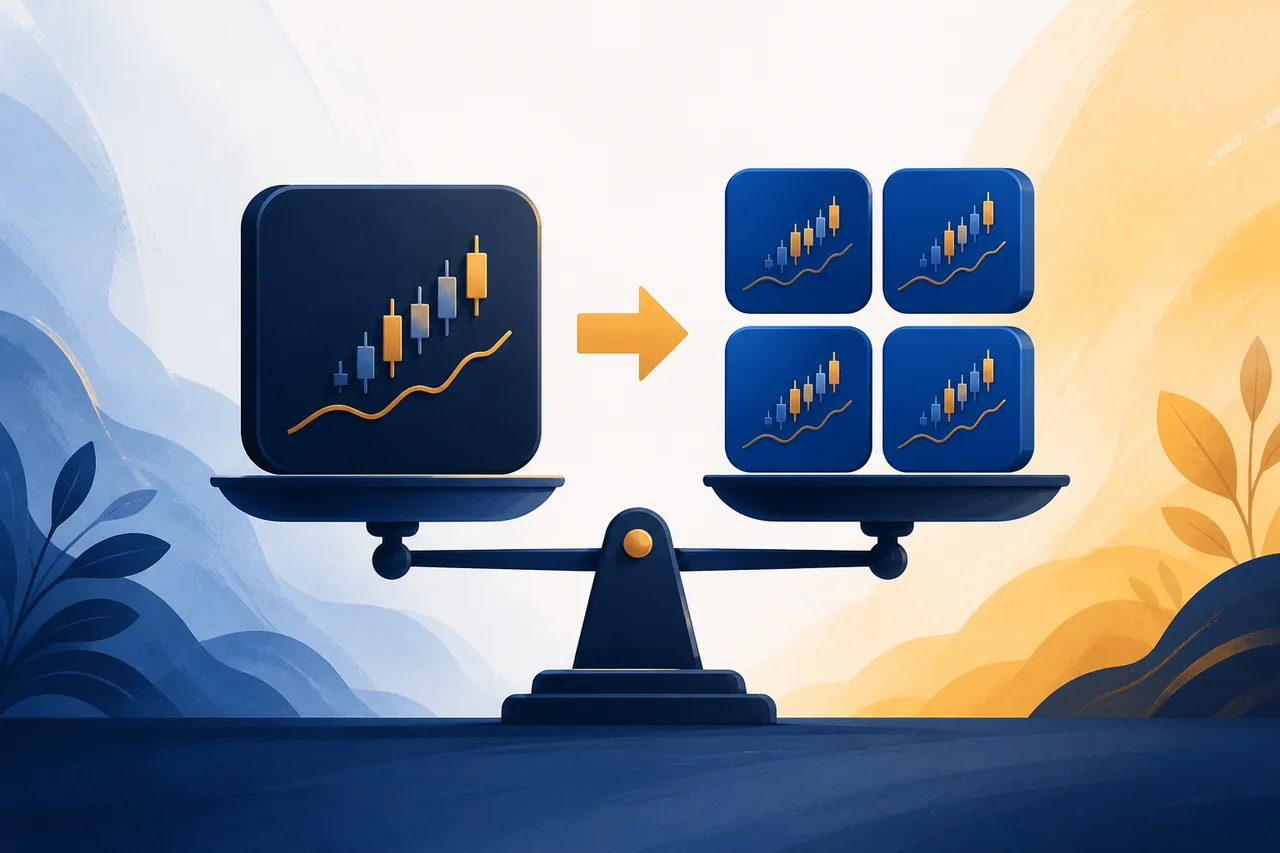
What a split changes
A stock split divides one share into several while changing the share price and count together. If one share becomes two, the theoretical price halves while the holder's total immediate interest remains unchanged. A split does not create earnings, cash flow, or competitive strength.
Different from enterprise value
Market capitalization is price times shares, so it is in principle unchanged by an equivalent split. Price can move after an announcement because expectations and trading conditions change, but that reaction is separate from the arithmetic. Do not treat the unit change itself as new enterprise value.
Reverse splits
A reverse split combines shares, increasing the price per share and reducing the count. It can be used for listing requirements or trading convenience and is not automatically positive or negative. Read why it was needed and any subsequent financing plan in the filing.
Adjust EPS and charts
Historical prices, EPS, dividends, and option exercise prices may be restated for comparability. Confirm whether an apparent chart movement is an actual return or a split adjustment. Multi-year per-share trends also require the same adjusted basis.
Liquidity effects
A lower price per share can change small-lot access or liquidity, but the outcome depends on market structure. That is why a split is not a purchase signal. Separate temporary attention and volume from sustained participation.
The arithmetic of a 2-for-1 split
Suppose a company has 10 million shares at 100,000 won each, for a 1 trillion won market capitalization. After a 2-for-1 split, there are 20 million shares at a theoretical 50,000 won each; the split alone does not double or halve the business value.
A filing review order
Review the ratio, record date, effective trading date, treatment of options and convertibles, and dividend adjustments. Then return to operating results and cash flow. A split changes the unit; investment analysis begins with the business represented by that unit.